Work
Work we’ve built and run
Each entry says what the problem was, what was done and where it stands now: client work, our own systems, or software still being developed. Client work is described without naming the business, and screenshots and films use fictional or demonstration data.
First builds we’d like to make next are listed separately at the end, and none of them exists yet.
Accounting and finance work
Ecommerce accounts reconstruction
Client work · Anonymised with permission
- Problem
- An ecommerce business needed company accounts, but its records did not explain the year-end position. The information sat across marketplaces, settlement statements, bank and currency accounts, the ledger and stock records.
- What was done
- Andrew reconciled gross trading to settlements, funds held by platforms and bank receipts, reconstructed the stock position, investigated ledger differences and made the corrections the evidence supported.
- Where it stands
- Completed. The company accounts were filed, with supporting schedules recording the corrections and the evidence questions that remain. HMRC accepted the tax filings for processing, which is not approval of the accounting treatment. Andrew went on to handle agreed payroll work for the business.
- Evidence
- The case study, with the scale of the work and how it was done
Ecommerce accounting across several marketplaces
Client work, running
- Problem
- Sales from several marketplaces exported and keyed in channel by channel, with the fee invoices and settlement reports behind them spread across each platform.
- What was done
- Sales from Amazon (UK and EU), eBay, TikTok Shop, Temu, Tesco, Debenhams and The Range brought into the accounts automatically. Each settlement is broken down into sales, fees, refunds and VAT and matched to the payment in the bank, and anything that doesn’t reconcile is flagged for review. A second system collects the fee invoices, credit notes, and settlement and transaction reports from each marketplace, using the access each seller authorises, checks which periods are missing anything, and files the records in the seller’s Google Drive.
- Where it stands
- Running. The connections are our own, with no paid connector plugins such as A2X or Dext Commerce. Each platform makes its documents available differently, and gaps in older periods are followed up rather than assumed complete.
- Evidence
- The settlement worksheet and the Amazon reserve example, both with fictional figures
Bookkeeping, payroll and year-end accounts
Running
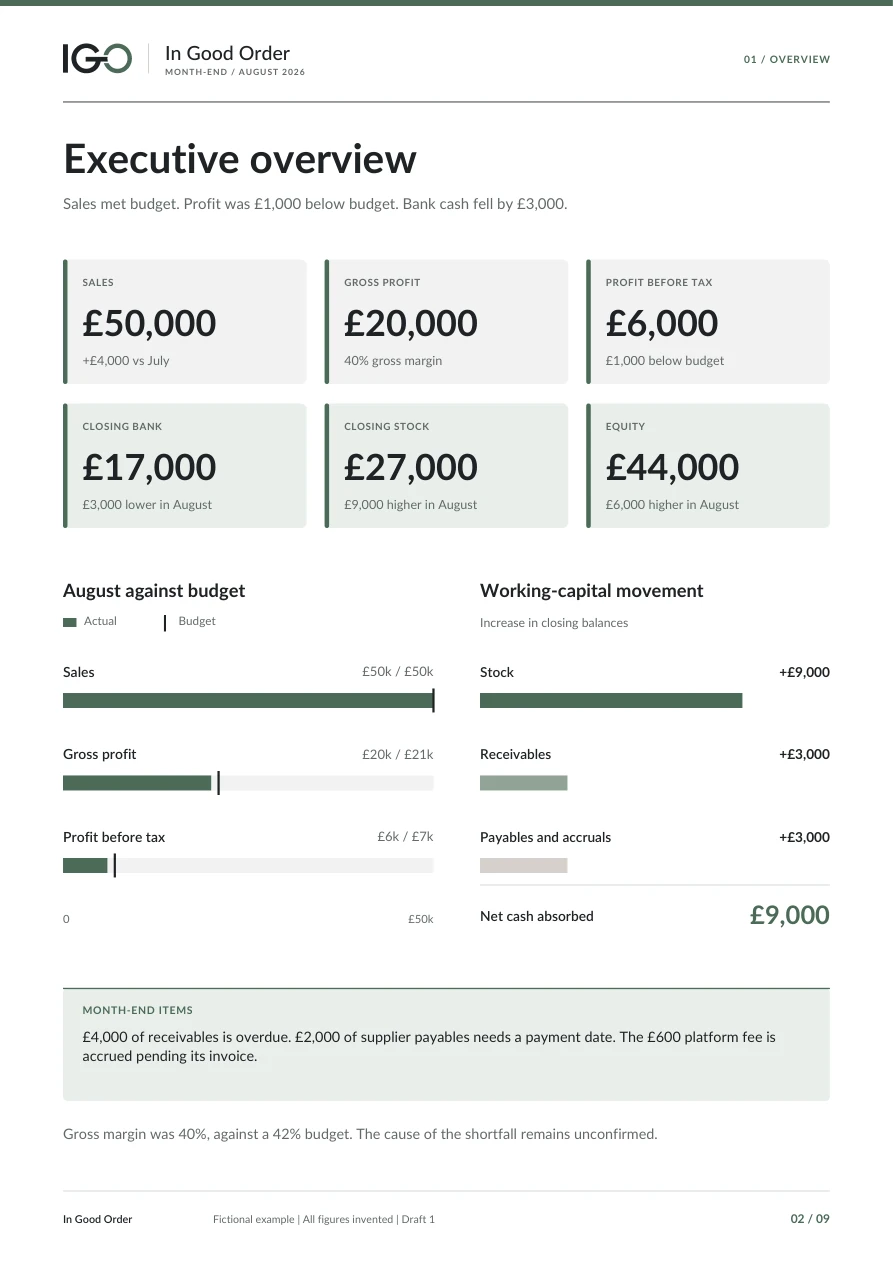
The first page of a fictional month-end pack. - Problem
- Accounting that has to happen every week, and the year-end it builds towards.
- What was done
- Bank reconciliation and document matching, with the receipt attached to each transaction and anything unmatched listed for review.
- Weekly payroll, from the hours submitted to a draft, an independent check, and a submission made only once it’s approved.
- Purchase bills created and matched by one agent and checked by another.
- A business’s accounts rebuilt through to a completed year-end: marketplace balances reconciled, stock and goods in transit cut off at the year end, tax adjustments made, and each figure indexed to its supporting evidence. The statutory accounts and tax returns were completed and filed.
- Where it stands
- Running. The purchase-bill agents are recent and still run under close review.
- Evidence
- An example month-end management pack (fictional data), and how payroll approval works
Software
PlateLedger
Working software, still being developed
- Problem
- Keeping each vehicle’s purchase, preparation costs, sale, payments and handover in one record that can still be traced when a sale changes.
- What was done
- Buying vehicles into stock, then tracking preparation and repair work until each one is ready to sell.
- Customer enquiries and follow-ups, sales proposals and part exchanges.
- Deposits, invoices and credit records, including supplier credits, the vehicle handover, and a digital deal pack for each sale.
- Profit worked out per vehicle, with staff access controls setting who can see and change what.
- Backup and restore, so a dealer’s records can be recovered.
- Where it stands
- Working software, developed with an independent dealership and still being developed. It was previously called Forecourt.
- Evidence
- The film below, made from a recreated interface and a fictional dealership, and the price-sheet and handover guides it was built around
Made from a recreated interface and a fictional dealership. The film still shows PlateLedger’s earlier name, Forecourt. The In Good Order CRM
Our own system, in use
- Problem
- In Good Order’s enquiries, proposals, client onboarding and commission in one record, with Andrew and his sales partner seeing only what their roles need.
- What was done
- A CRM built for In Good Order’s own sales and client work, from the first enquiry to an agreed engagement and recurring fees. It keeps a proposed monthly fee apart from money actually received, and commission follows the recorded payment, with refunds kept against the original receipt.
- Where it stands
- In use for In Good Order’s own work.
- Evidence
- Screenshots with fictional figures and sample records
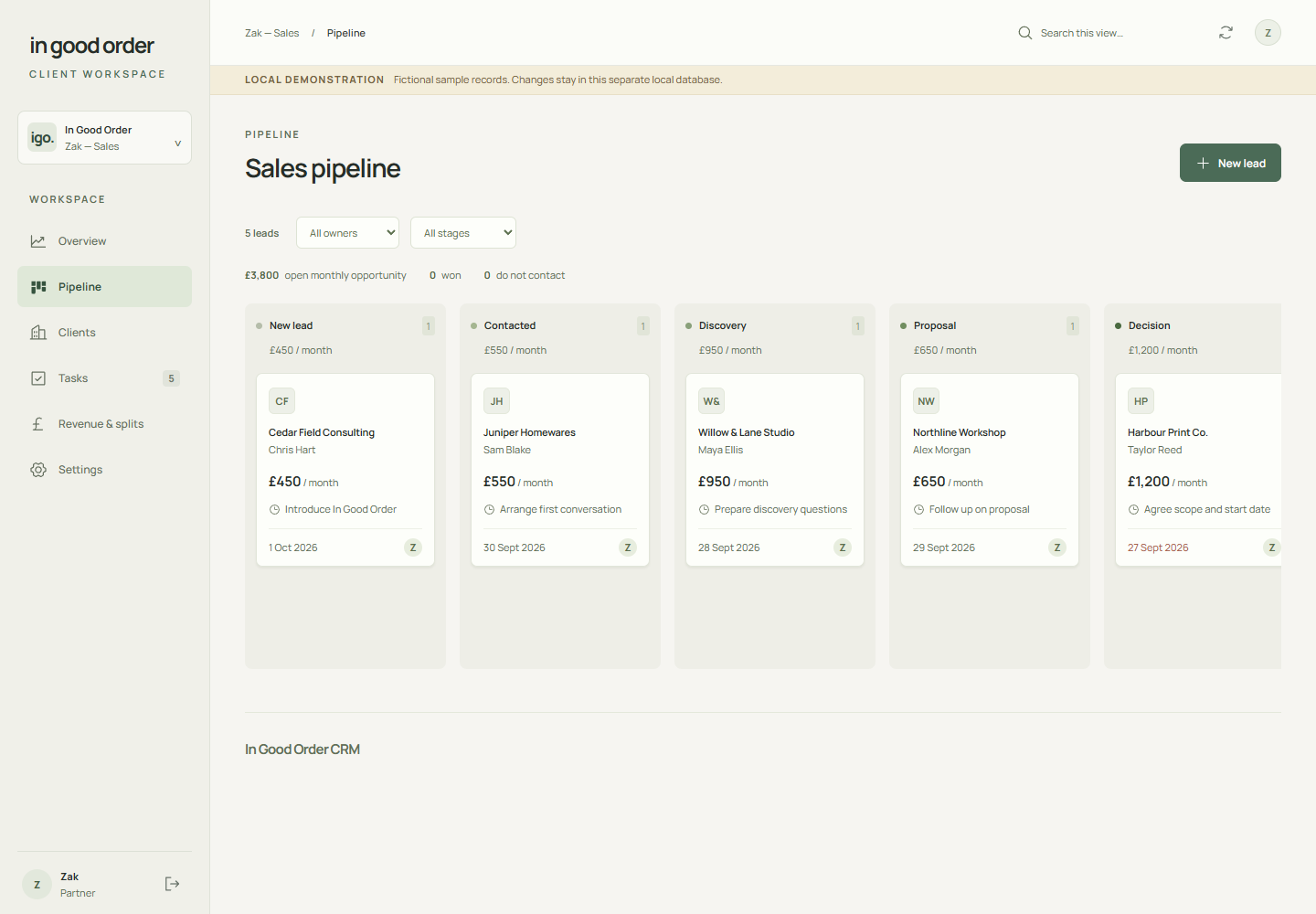
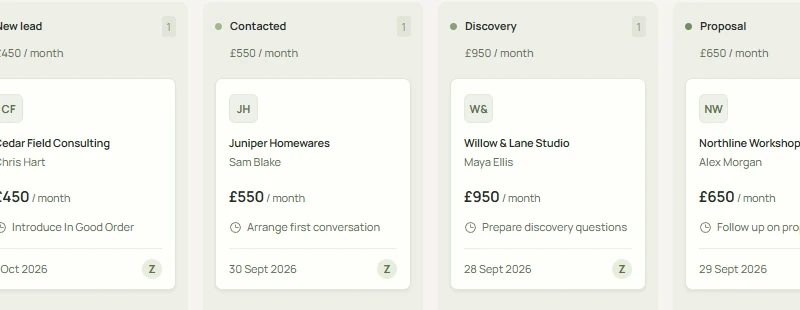
The sales pipeline, with the outlined stages at full size: each opportunity carries its proposed monthly fee and its next action. Fictional figures and sample records. A bespoke CRM, built from scratch
Client work, deployed
- What was done
- Written around the way one business runs, so sales, operations and marketing work from the same customer records. Each role sees only what it needs, commission is calculated from rules the business can change, and every payout is linked to the receipts behind it.
- Where it stands
- It was deployed and used in that business. The business isn’t named, and there are no public screenshots.
Framewright
Our own project, built and used
- What was done
- A parametric timber-frame studio. It draws plans, sections, elevations and 3D views, works out the length of every member, and turns those into cutting schedules and buying lists.
- Where it stands
- We used it to design our own extension, then built the extension from its drawings. The film was made from the same model and photographs of the build.
Drawn
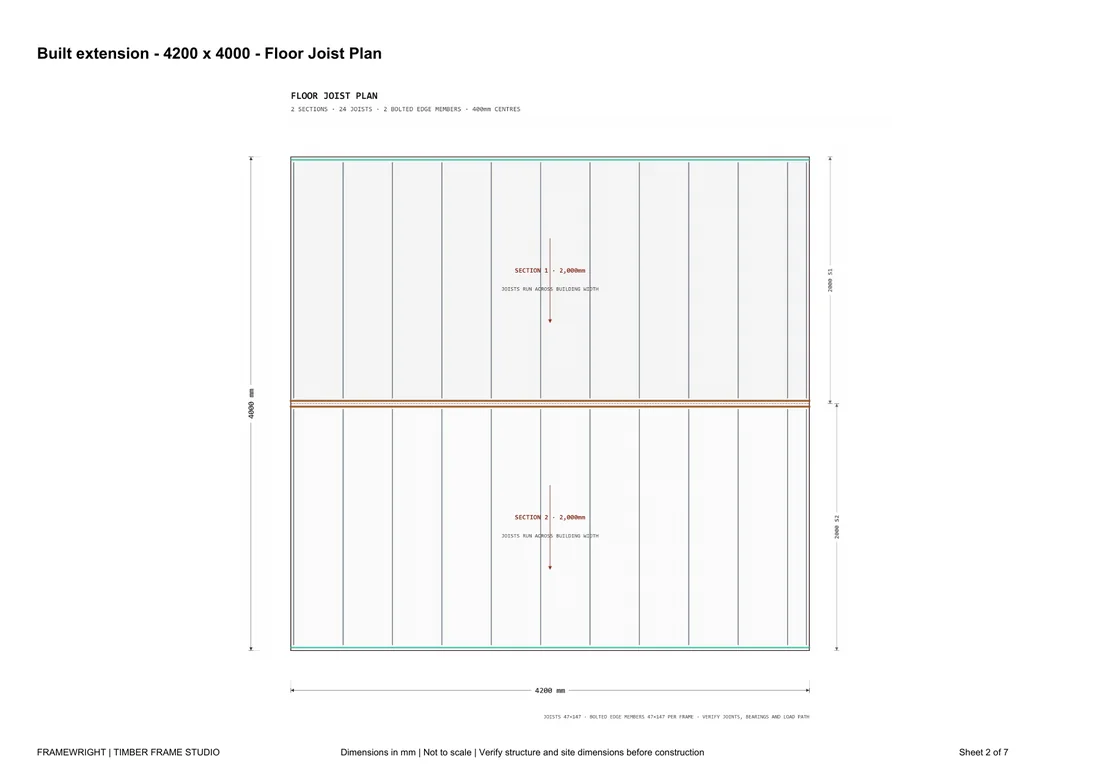
Sheet 2 of 7, the floor joist plan
Cut
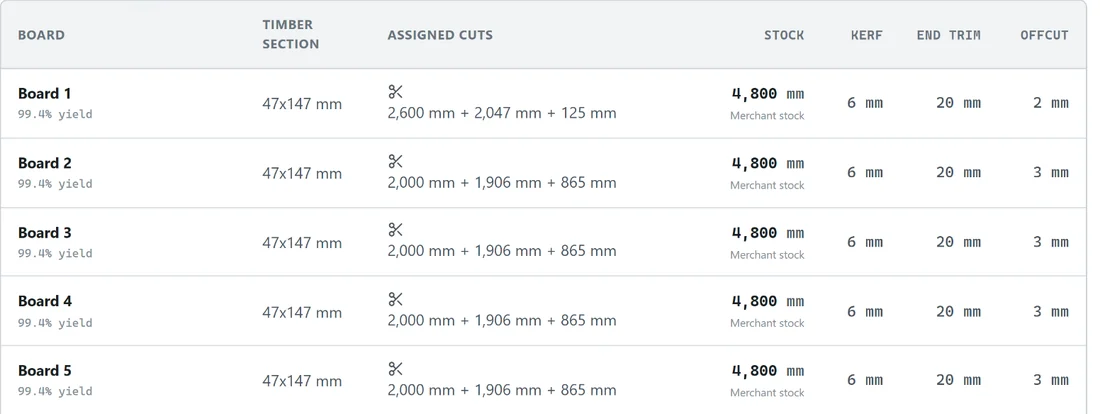
Every member’s length, assigned to stock boards
Built
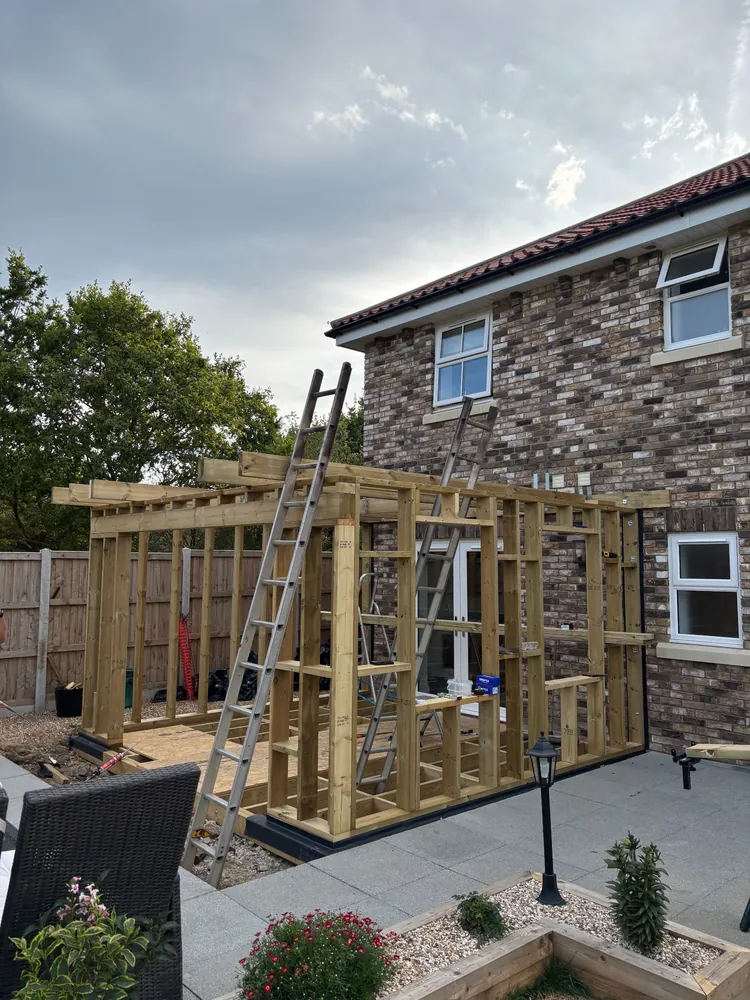
The frame, built from those drawings
Filmed
Framewright’s own drawing and cutting list for our extension, the photograph of the frame on site, and the film made from the same model.
Systems that run recurring work
Inbox triage and a daily owner brief
Built
- What was done
- Email across several inboxes sorted into action and information, routed to the person who deals with it, with notifications kept to what needs attention. We’ve also built triage for WhatsApp messages. A daily brief draws together open decisions, deadlines and the results from the other agents, and raises anything they couldn’t resolve.
Estimating and job-cost analysis
Built
- What was done
- Estimates for industrial work built from quantities taken off the drawings, with allowances for crews, shifts, travel and consumables. For finished jobs, we rebuilt what was quoted against what was actually spent from the original records.
- Result
- The same work produces management packs in which each cost and margin traces back to a source document.
Getting noticed and finding work
Promotional material from ten years of records
Client work, completed
- What was done
- We went back through ten years of a business’s own email and accounting records to recover the detail of jobs it had done. That became promotional material, and a list of article subjects drawn from work the business had actually carried out. The records themselves stayed private.
- Also
- We’ve also written service pages and carried out technical SEO and indexing work.
Lead and tender research
Running
- What was done
- Recurring searches for relevant tenders and opportunities, and a weekly pack of newly registered companies with a draft introduction for each, ready for someone to review before anything is sent. Research into available funding runs alongside.
Examples you can read or download
All the figures in these are invented, so they can be shared.
Month-end management pack
A nine-page fictional management pack: performance against budget, profitability, financial position, cash and actions, with the stock and cash bridges reconciled.
Marketplace settlement worksheet
An Excel worksheet for reconciling marketplace activity to payouts and the closing platform balance, with any unexplained difference kept visible instead of forced to zero.
Global Accounting working paper
An Excel working paper with the Global Accounting examples and a blank sheet for consecutive VAT periods, including a shortfall carried forward.
Not built yet
Looking for the next business to build with
These are first builds we’d like to make with a business that has the problem. None of them exists yet. Each would start small, with one business and the records it already keeps, and what it can do depends on the data and access available.
Manufacturers and workshops
- First build
- A record of downtime and scrap for one line or cell, with each job’s margin worked out from what the run actually used.
- Uses
- The production and job records you already keep: run times, stoppages, scrap counts and material issued, taken from exports or the systems that hold them. We’d check what can be read before suggesting anything is connected to a machine.
- You decide
- Which stoppages and scrap to tackle first, and whether a job’s price or method changes.
- The aim
- Seeing which bottlenecks keep recurring, and what scrap does to each job’s margin.
Cafés, restaurants and takeaways
- First build
- What each dish earns, from till sales joined to its ingredient costs and the waste recorded against it.
- Uses
- Till exports, the supplier invoices for ingredients, and a simple waste record kept by the team.
- You decide
- Menu changes, prices, prep quantities and what to buy for each season.
- The aim
- Menus and orders set with each dish’s margin and demand in view.
Trades and contractors
- First build
- Each job’s labour and materials tracked against its quote while the work is under way.
- Uses
- Quotes, timesheets, supplier invoices and materials orders, matched to the job they belong to.
- You decide
- What to do when a job’s costs start drifting from the quote, before it’s finished.
- The aim
- Margin problems found while there’s still time to act, and later quotes priced from your own job history.
Wholesalers and distributors
- First build
- A comparison of suppliers for the goods you buy most often, on what each costs once it arrives. This is the supplier comparison described under finding where margin is lost.
- Uses
- Supplier price lists, the freight and duty on past invoices, minimum order quantities, lead times, and your own record of quality problems.
- You decide
- Which supplier to order from. The comparison recommends, and you place the order.
- The aim
- Buying decisions made on landed cost rather than the list price.
Retailers selling on several channels
- First build
- A weekly list of the lines likely to run out or slow down, across every channel, with a suggested reorder for each.
- Uses
- Sales and stock records from each channel and the stockroom, and each supplier’s lead time.
- You decide
- Every reorder. Nothing is ordered until you approve it.
- The aim
- Fewer lines running out, and less money tied up in slow stock.
Service businesses
- First build
- One record that carries each enquiry through to a booked job and its follow-up, with the diary showing the capacity you really have.
- Uses
- The enquiry inbox and website forms, and the booking diary and staff rota.
- You decide
- Which work to take on and when. Follow-ups are drafted for you to approve.
- The aim
- Enquiries, jobs and follow-ups that don’t go missing.
Equipment hire and servicing
- First build
- A maintenance plan for each machine, worked out from its recorded use and its past failures.
- Uses
- Hire or service records, the hours or mileage logged, and the repair history.
- You decide
- When each machine is serviced or replaced.
- The aim
- Servicing planned before things fail, from records you already keep.
Businesses with detailed technical records
- First build
- A search over one set of manuals and past job files that answers a question and links the answer to the record it came from.
- Uses
- The manuals, job sheets and reports you choose to include.
- You decide
- Which records are included and who can search them.
- The aim
- Answers your team can check against the source.
Have a business where one of these would help? We’re open to building selected first projects at a reduced price. It starts with a free review, and the scope and price are agreed before any work begins.
Show us what’s taking too long
A sentence or two about the work is enough. You’ll speak to Andrew, who builds the systems and takes responsibility for the accounting, about whether it’s worth doing.
Before anything is built, the starting record is written down and agreed, so the saving can be checked against it: how an engagement works.
The first review is free. The price list gives guide prices for one-off builds, and explains how a monthly arrangement works if we run the work for you.
Opens a short enquiry form. Nothing is sent until you press Send enquiry.
Prefer email? Write to andrew@ingoodorder.co.uk.